
Small Part, Big Job: Why the Capacitor is the Heartbeat of Your AC
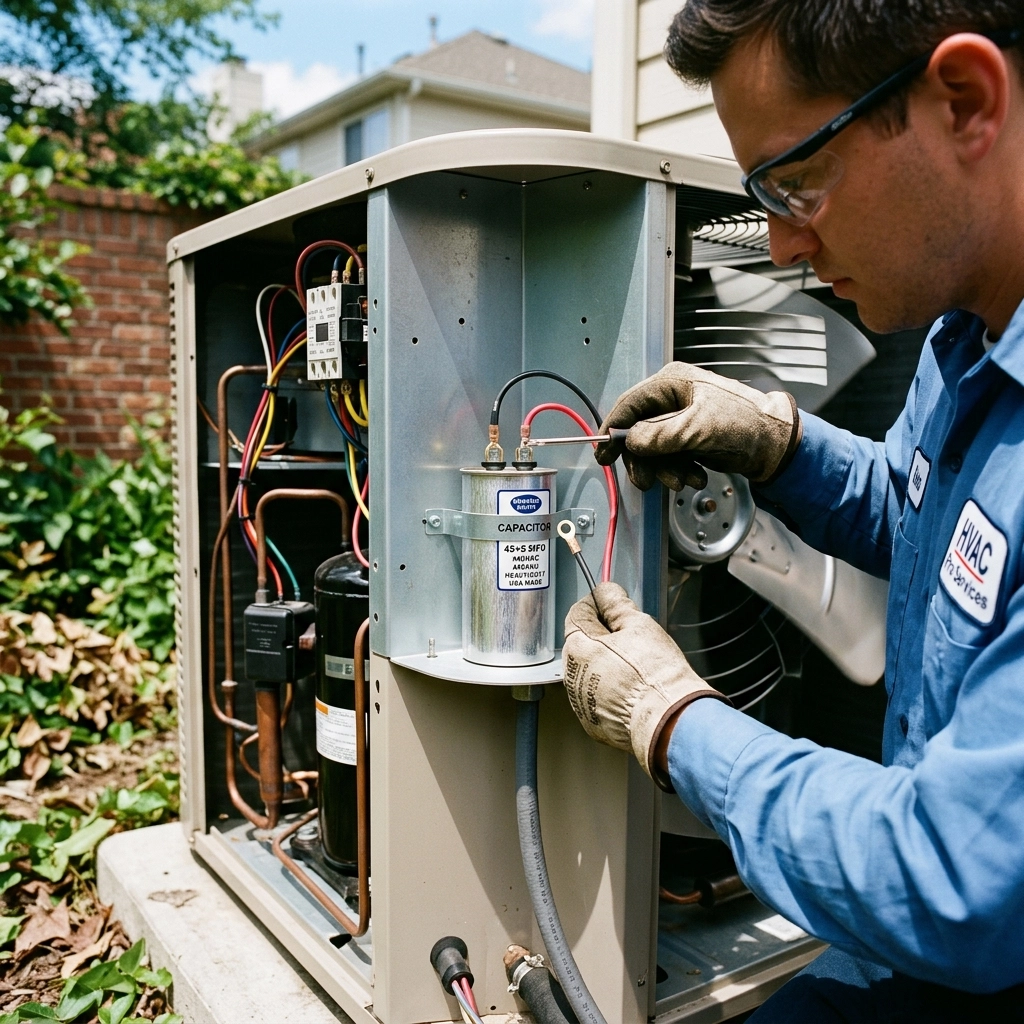
You’re sitting on the couch on a Saturday afternoon in late April, just as the Texas humidity starts to really lean on your front door. You hear the thermostat click. You wait for that familiar whoosh of cool air from the vents. But instead of the breeze, you hear a faint, struggling “Mmmmmmmmmmm”. It’s a low hum coming from the outdoor unit that sounds like it’s trying to lift something way too heavy.
If that sounds familiar, you’ve likely met the most common “small but mighty” failure in the world of HVAC: the capacitor.
At Accu-Temp Air Conditioning & Heating, we see this specific issue more than almost any other. It’s a part that’s small and costs a fraction of what a new system does. Yet without it, your high-tech AC is basically just a very expensive lawn ornament.
In this post, we’re going to dive into why this little component is the literal heartbeat of your system, why the Austin heat is its worst enemy, and how catching a failing capacitor early can save you thousands of dollars in motor repairs.
What Exactly is a Capacitor? (The “Battery Boost” Analogy)
To understand what a capacitor does, think about your car. Your car has a battery that provides a massive surge of electricity to the starter motor to turn the engine over. Once the engine is running, the alternator takes over, but you couldn’t get moving without that initial “jolt.”
An air conditioning compressor and the fan motors are heavy-duty pieces of equipment. When they are at a dead stop, it takes a massive amount of torque to get them spinning. It takes about three to five times more power to start a motor than it does to keep it running.
Your home’s electrical system is steady, but it isn’t designed to provide that sudden, massive “kick” of energy all at once. That’s where the capacitor comes in.
A capacitor is an energy-storage device. It sits there, soaking up electricity and holding it in reserve. When the thermostat calls for cooling, the capacitor “dumps” all that stored energy into the motor in a split second. This provides the “battery boost” the motor needs to overcome inertia and start spinning.
Start vs. Run: The Two Jobs of a Capacitor
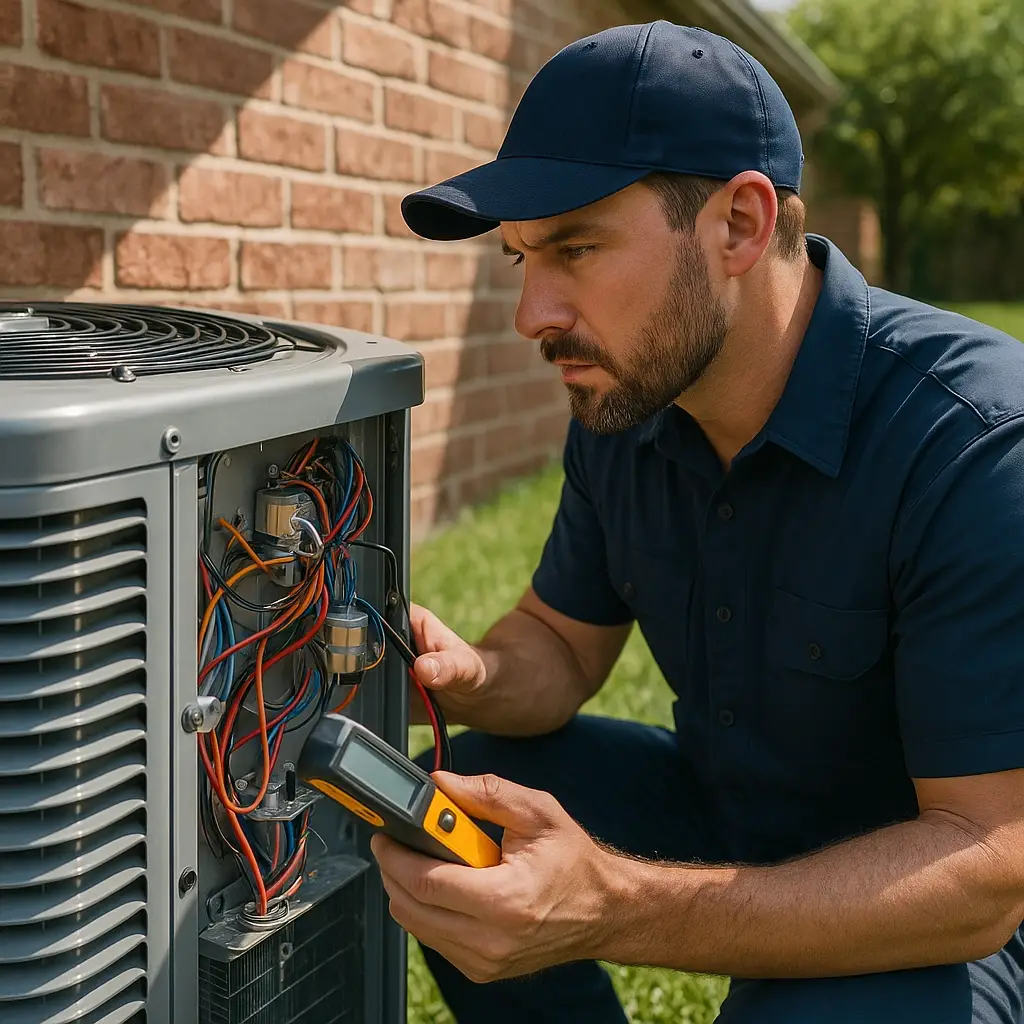
In many modern systems, we use what’s called a dual-run capacitor. This single component actually handles two different motors: the compressor (the “heart” that pumps refrigerant) and the fan motor (which blows air across the coils).
There are two main types of work these parts do:
- The Start: This is the initial burst we talked about. Without this “kick-start,” the motor just sits there, receiving a standard electrical current but unable to move. This is where that humming sound comes from: it’s electricity trying to work, but the motor is stuck.
- The Run: Some motors need a constant, smaller “boost” to stay efficient and keep their timing right while they are spinning. A run capacitor stays in the circuit to keep the power flow smooth and steady.
If either side of that capacitor fails, the corresponding motor is in big trouble.
Why the Texas Heat is a Capacitor Killer
If you live in Austin or the surrounding areas, you know our summers aren’t just hot: they are relentless. Your AC system might run for 12, 14, or even 18 hours a day during a July heatwave.
Capacitors are filled with a special oil and conductive materials that are very sensitive to temperature. As they work, they naturally generate a little heat. Add sun beating down on the metal cabinet of your condenser and the internal temperature of that capacitor can skyrocket.
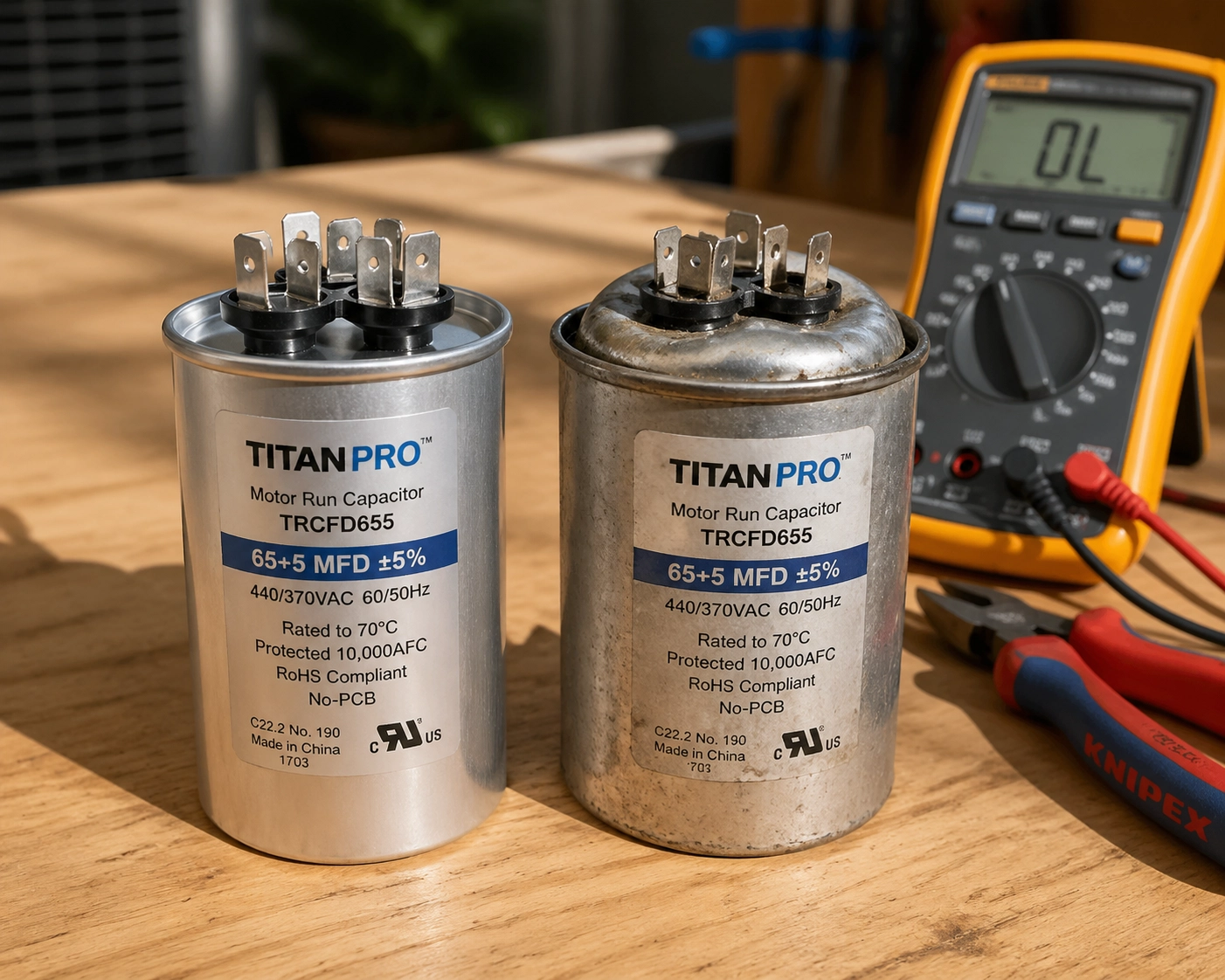
Over time, that heat causes the oil inside the capacitor to expand. If you’ve ever seen a technician pull out a capacitor that looks “swollen” or has a bulged-out top (like a soda can that’s been left in a freezer), that’s the result of heat and pressure. Eventually, the internal seals pop, the fluid leaks or dries up, and the part “dies.”
This is why we see a massive spike in service calls at Accu-Temp Air Conditioning & Heating the very first week the temperature stays above 90 degrees. The old, weakened capacitors from last year just can’t handle the new season’s heat.

The “Humming” Warning Sign
One of the best things you can do as a homeowner is to listen to your equipment. A healthy AC unit has a very distinct sound: a click, a brief whir of the fan, and then the deep rumble of the compressor.
If you hear the following, your capacitor is likely on its way out:
- The Hum: You hear a steady electrical buzz or hum from the outdoor unit, but the fan isn’t spinning.
- The Click-No-Start: The unit clicks like it wants to turn on, but nothing happens, and then it clicks again a few minutes later.
- Smoke or Burning Smell: If the capacitor completely shorts out, it can sometimes produce a “hot electronics” smell.
- Weak Airflow: If the run capacitor is failing, the fan might spin, but at a much lower RPM than usual, meaning your house never really gets cold.
When you catch these signs early and call for HVAC services, you can usually swap the part out before any permanent damage occurs. If your system is tripping the breaker, learn more about that here.
How a Small Part Prevents Big Damage
People often ask us, “If the capacitor is dead, can’t I just let the unit try to start until I have time to fix it?”
The answer is a hard NO.
When a motor tries to start without the help of a capacitor, it pulls a massive amount of “Inrush Current.” Since the motor isn’t turning, all that electrical energy is converted directly into heat. This heat sits inside the windings of your compressor or fan motor.
If this happens repeatedly, the heat will melt the insulation on the motor wires. Once that insulation melts, the motor “shorts to ground” or burns out completely.
- A capacitor replacement: Relatively simple, common, and affordable.
- A compressor replacement: Often costs thousands of dollars and, on older units, this could mean you have to replace the entire system if the refrigerant type is outdated.
By being the “heartbeat” that ensures a smooth start, the capacitor is actually the primary bodyguard for your system’s most expensive components.
Why This Isn’t a DIY Project
We’re all for being handy around the house, but the capacitor is one area where we strongly recommend calling the pros. For more tips on what you should or shouldn’t try to fix on your own, read our post here.
Capacitors are designed to store a massive electrical charge: and they can hold that charge even after the power to the AC has been turned off. If you touch the terminals of a charged capacitor with your bare hand or a non-insulated tool, it can deliver a lethal shock.
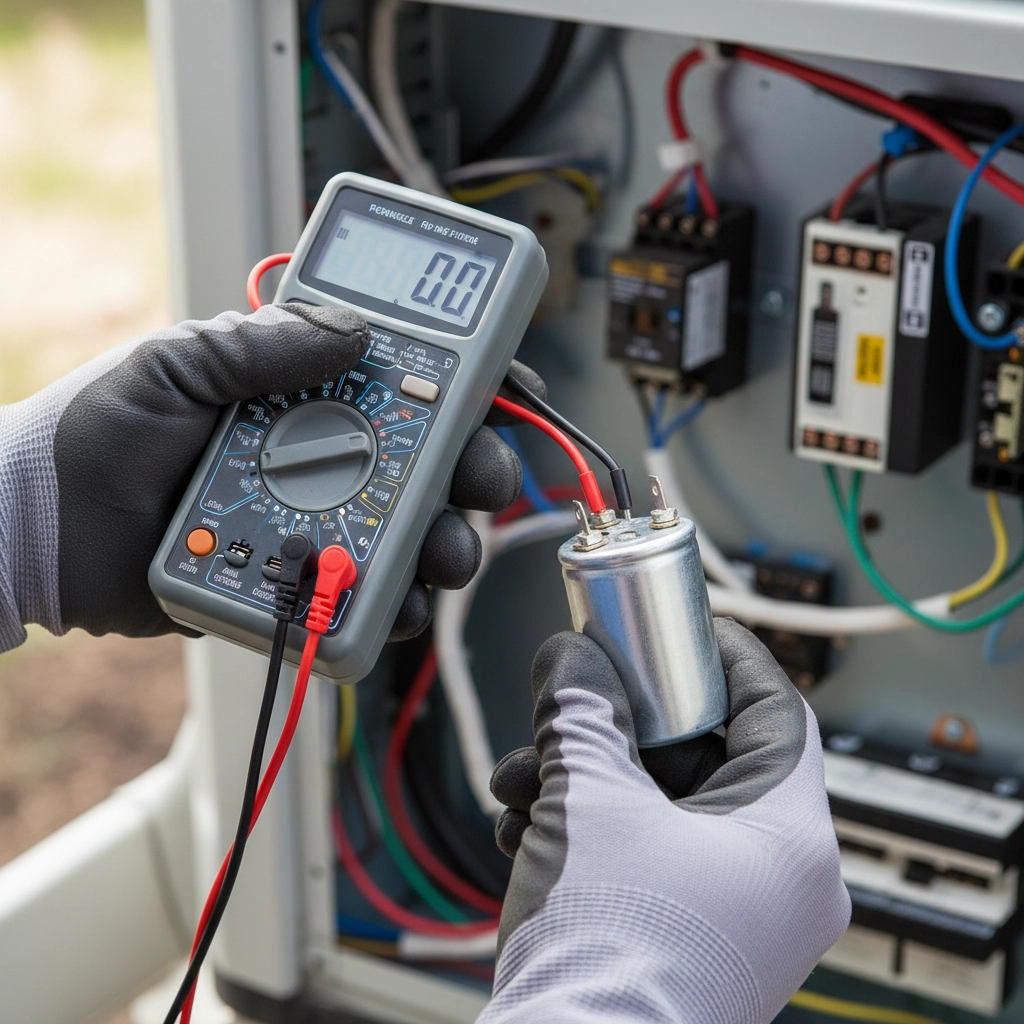
Our technicians at Accu-Temp are trained to safely discharge the stored energy and use specialized meters to test the “Microfarads” (the unit of measurement for capacitance). Sometimes a capacitor hasn’t “popped” yet, but its reading is 10% or 20% below what it should be. We call this “failing out of spec.” Replacing it then is proactive maintenance that prevents a breakdown on a Sunday night when it’s 100 degrees out. Want to rule out an easy fix first? Read our post about things to check when your system isn’t working here.
Part of Your Seasonal Tune-Up
Because capacitors are so prone to failure in the heat, checking them is a standard part of our multi-point inspections. We don’t just look to see if the AC is running; we check the “health” of the heartbeat.
If we see a capacitor that is starting to bulge or one that is testing low, we’ll let you know. It’s much easier (and cheaper) to swap that part out during a scheduled visit than it is to deal with an emergency repair when your house is sweltering.

Keeping Your Cool in the Lone Star State
At the end of the day, your AC system is a complex machine with a lot of moving parts, but it often relies on the simplest ones to do the heavy lifting. The capacitor might be small, but it’s the spark that keeps your home comfortable.
If your AC is acting up, making strange humming noises, or if you just haven’t had it checked out since last summer, give us a shout. We’ve been helping our neighbors in the Austin area stay cool for years, and we’d love to make sure your system’s “heartbeat” is strong for the season ahead.
Ready to schedule your spring tune-up? Contact Accu-Temp Air Conditioning & Heating today, and we’ll make sure your system is ready to handle whatever the Texas sun throws at it!